 condoo.Vibe
Twilio
Connect Twilio to send SMS confirmations, reminders, and alerts triggered by real events inside the apps you build with condoo.Vibe.
Twilio lets applications you build with condoo.Vibe communicate with users through channels such as SMS.
You can use Twilio to build communication workflows for:
- Appointment reminders
- Booking confirmations
- Order updates
- Lead notifications
- Verification messages
- Customer alerts
- Status updates
- Internal team notifications
Once Twilio is connected, describe who should receive a message, when it should be sent, and what it should say.
Connect Twilio. Define the event. condoo.Vibe builds the communication workflow.
What You Can Build with Twilio
Twilio can add real-time communication to many types of applications.
Appointment reminders
Send customers an SMS reminder 24 hours before their appointment.
Booking confirmations
Send the customer a confirmation SMS after their booking is successfully created.
Order updates
Notify customers by SMS when their order has been shipped.
Lead notifications
Send the assigned sales representative an SMS when a high-value lead enters the CRM.
Account alerts
Notify users when an important action occurs on their account.
Twilio becomes the communication service behind the workflow you define.
Before You Start
You'll need a Twilio account and the credentials required by the condoo.Vibe Twilio connector.
Depending on the functionality you're building, you may also need a Twilio phone number or other Twilio configuration.
Connect Twilio to condoo.Vibe
Open your condoo.Vibe project and navigate to Connectors.
Find Twilio and select it.
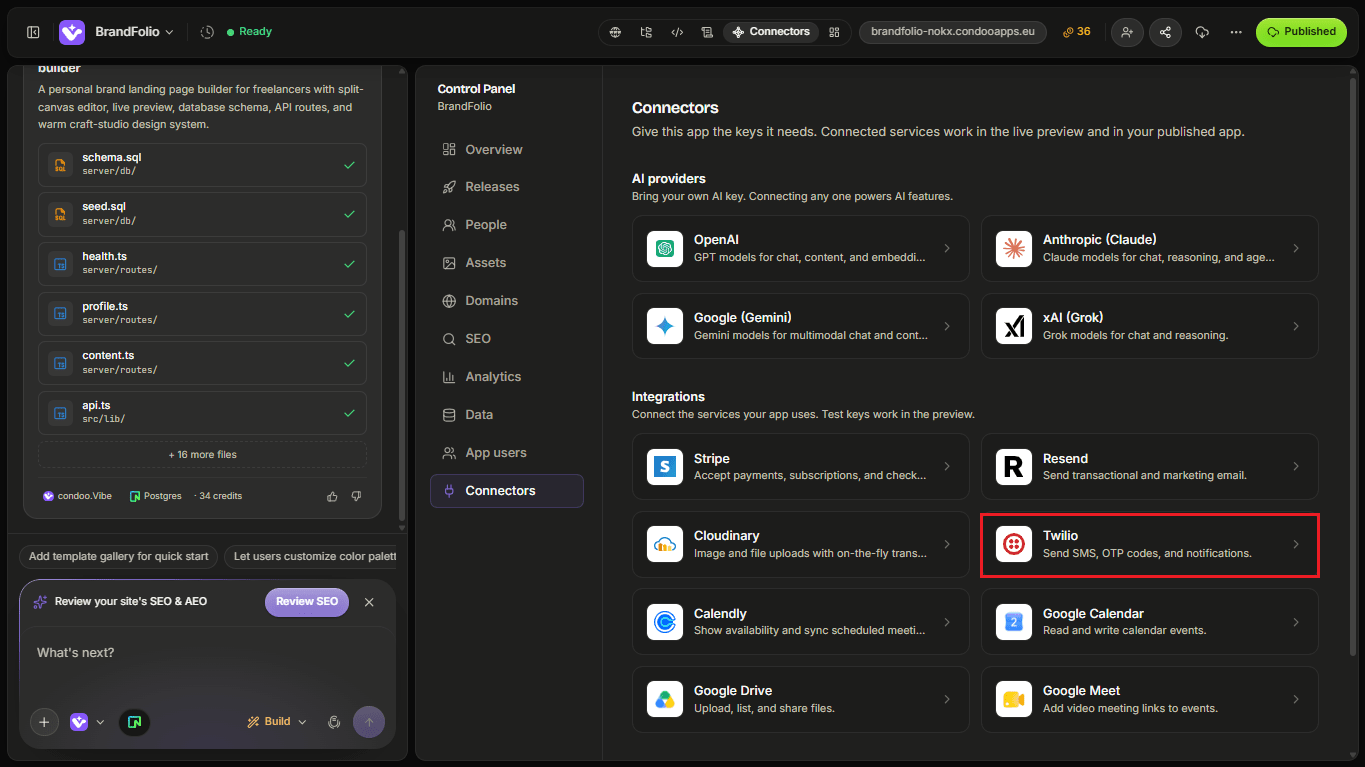
Enter the credentials requested by condoo.Vibe and save the connection.
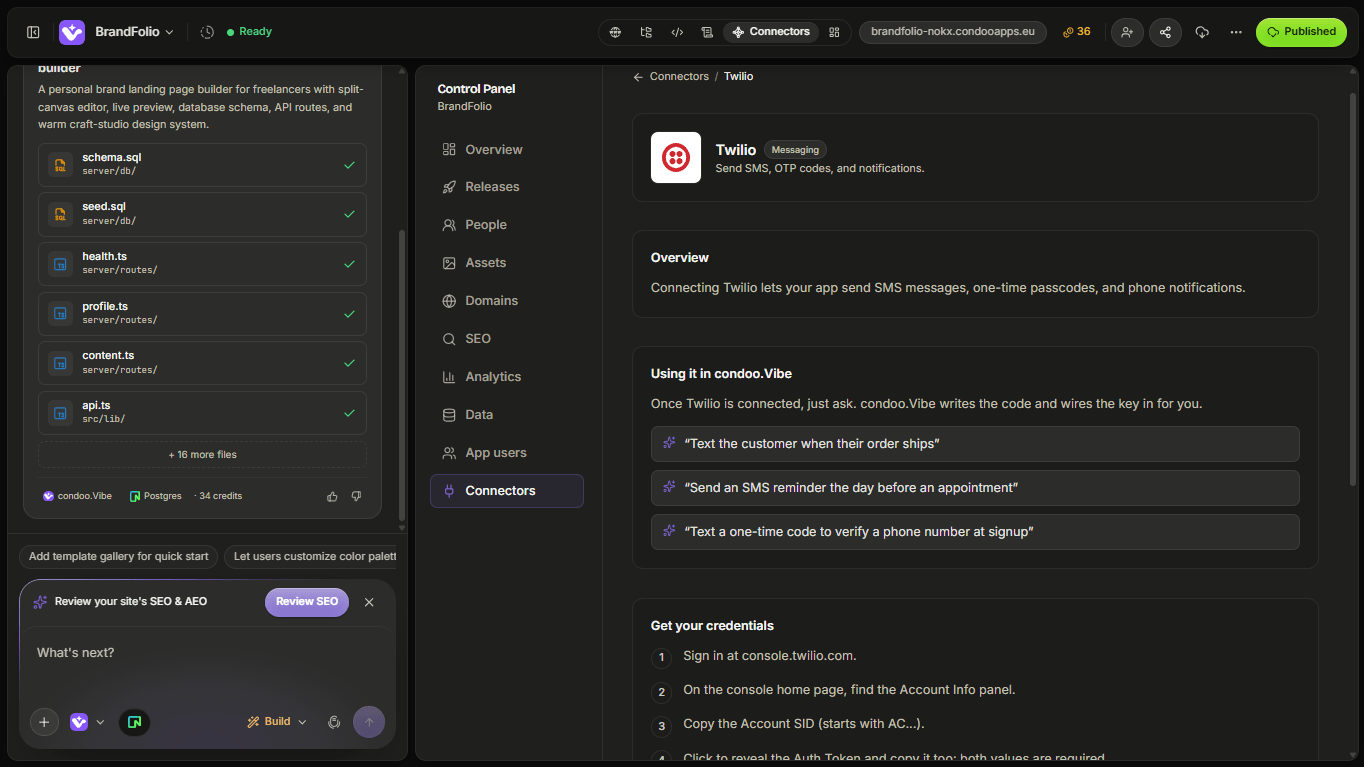
Once connected, you can begin asking condoo.Vibe to add Twilio-powered functionality to your application.
Build Your First SMS Workflow
Suppose you're building a booking application.
You could tell condoo.Vibe:
After a booking is successfully confirmed, send the customer an SMS containing the service, appointment date, time, and booking reference.
Conceptually:
Booking Confirmed
       ↓
Save to Neon
       ↓
Server-Side Logic
       ↓
Twilio
       ↓
Customer receives SMS
The message is triggered by something happening inside your application.
Define the Trigger
Be clear about when the message should be sent.
Instead of:
Send customers an SMS.
Try:
Send the customer an SMS immediately after their appointment is successfully confirmed.
Or:
Send the assigned sales agent an SMS when a new lead with an estimated value above $10,000 is created.
The event is what activates the workflow.
Define the Recipient
Tell condoo.Vibe where the recipient's phone number comes from.
For example:
Send the SMS to the phone number the customer provided during booking.
Or:
Send the notification to the assigned agent's saved phone number.
For applications that collect phone numbers, make sure the appropriate field exists and is validated.
Define the Message
SMS works best when messages are concise.
For example:
Your consultation with Acme has been confirmed for
Sept 15 at 2:00 PM. Ref: BK-10482.
You can use dynamic application data inside the message.
For example:
Personalize the SMS with the customer's first name and include their appointment date, time, and booking reference.
Phone Numbers
Phone-number formatting matters when sending messages internationally.
A phone number should generally be stored in a format that clearly identifies its country.
For example:
+14155550123
rather than relying only on:
4155550123
If your application serves users in multiple countries, consider collecting the user's country alongside their phone number or using a phone input that handles international dialing codes.
Validate Phone Numbers
Don't wait until Twilio attempts delivery to discover that required phone information is missing.
For example:
Make phone number required for SMS appointment reminders and validate the number before saving the booking.
You should also decide what happens if a customer doesn't provide a valid number.
Example: Appointment Reminders
One of the most useful Twilio workflows is automated reminders.
Suppose your application stores:
Customer
Sarah Chen

Service
Strategy Consultation

Appointment
September 15, 2:00 PM

Phone
+1...
You could ask condoo.Vibe:
Send customers an SMS reminder 24 hours before their confirmed appointment. Include the service, appointment date, and time.
Conceptually:
Confirmed Appointment
        ↓
Wait until reminder time
        ↓
Still confirmed?
        ↓
Twilio
        ↓
SMS Reminder
Notice the additional condition:
Still confirmed?
You don't want to remind someone about an appointment that has already been cancelled.
Example: Booking Confirmation
You can combine email and SMS.
For example:
After a booking is successfully confirmed, send the customer a detailed confirmation email through Resend and a short confirmation SMS through Twilio.
The workflow becomes:
Booking Confirmed
       ↓
Save Booking
       ↓
   ┌───┴────┐
   ↓        ↓
Resend     Twilio
   ↓        ↓
Email      SMS
Multiple connectors can participate in the same product workflow.
Example: High-Value Lead Alert
Twilio can also be useful for internal notifications.
Suppose your sales team wants immediate alerts for valuable opportunities.
When a new lead is created with an estimated budget of $10,000 or more, mark the lead as High Priority and send the assigned sales representative an SMS containing the lead's name, company, and estimated budget.
Conceptually:
New Lead
   ↓
Check Budget
   ↓
$10,000+?
 ↙      ↘
Yes      No
 ↓        ↓
High    Normal
Priority
 ↓
Twilio
 ↓
Sales Alert
This combines database logic with external communication.
Example: Order Updates
For an e-commerce application:
When an order status changes to Shipped, send the customer an SMS containing their order number and tracking information.
The trigger isn't the customer clicking a button.
It's a change in application data.
This allows communication to follow the lifecycle of a record.
SMS Consent
Before sending automated or marketing-related messages, make sure your application collects any consent required for your use case and the countries where you operate.
For example, your form may include an appropriate consent option for receiving SMS notifications.
For high-volume or promotional messaging, review Twilio's requirements and applicable regulations before launching.
Transactional vs Marketing Messages
There's an important difference between:
Your appointment is confirmed for tomorrow at 2 PM.
and:
Get 30% off when you book another appointment today!
The first is related to an existing customer transaction.
The second is promotional.
Different requirements may apply depending on your location, recipient location, and type of message.
Design your messaging workflow accordingly.
Don't Send Messages from the Frontend
Twilio authentication credentials shouldn't be exposed in browser code.
The safer conceptual architecture is:
USER ACTION
    ↓
YOUR APPLICATION
    ↓
SERVER-SIDE LOGIC
    ↓
TWILIO
    ↓
SMS
rather than having the user's browser directly contain sensitive Twilio credentials.
condoo.Vibe can build the appropriate server-side workflow around your connector.
Handle Delivery Failures
An SMS may fail to send even though the primary application action succeeds.
For example:
Booking Created ✓
SMS Failed ✕
That doesn't necessarily mean the booking itself should be cancelled.
You can define the behavior:
If the booking is created successfully but the confirmation SMS fails, keep the booking confirmed. Record the messaging failure without cancelling the appointment.
This separates the core application action from the notification.
Avoid Duplicate Messages
Make sure the same application event doesn't unnecessarily trigger multiple messages.
For example:
Send one confirmation SMS when the booking is first confirmed. Don't send another confirmation simply because the customer views or refreshes the booking page.
Your message should be tied to the correct event.
Common Problems
SMS isn't sending
First determine whether the rest of the workflow works.
For example:
The booking is being created successfully, but the customer isn't receiving the SMS.
Then use Debug Mode to investigate the Twilio portion.
Invalid phone number
Check that the phone number is present and formatted appropriately for the destination.
For international applications, pay particular attention to country codes.
Twilio rejects the request
The error returned by Twilio can provide useful information.
Copy the error message into Debug Mode without including sensitive credentials.
Some countries receive messages and others don't
Messaging availability and requirements can differ by destination.
Check whether your Twilio account, sender, number, and messaging configuration support the affected destination.
Customers receive duplicate messages
Tell condoo.Vibe:
Customers sometimes receive two confirmation SMS messages for one booking. Investigate the trigger and ensure a confirmed booking produces only one confirmation SMS.
Debugging Twilio
A useful debugging request looks like:
Expected: After a booking is confirmed, the customer should receive an SMS.
Actual: The booking is created correctly, but no SMS is received.
The customer's phone number is saved on the booking.
Error: [PASTE ERROR IF AVAILABLE]
Debug the Twilio portion of the workflow without changing the existing booking functionality.
This gives condoo.Vibe a specific area to investigate.
Test Your Workflow
Before publishing, test more than whether one SMS arrives.
Check:
- Is the message triggered at the correct time?
- Does it go to the correct number?
- Is dynamic information correct?
- Are dates and times correct?
- What happens with an invalid number?
- What happens if Twilio rejects the request?
- Are duplicate messages prevented?
- Are cancelled bookings excluded from reminders?
- Does the core action still succeed if the notification fails?
For applications operating internationally, test the destinations you actually intend to support.
A Good Twilio Prompt
A strong communication request defines:
- Trigger: When?
- Recipient: Who?
- Message: What?
- Conditions: Under what circumstances?
- Failure behavior: What happens if delivery fails?
For example:
Send customers an SMS reminder 24 hours before confirmed appointments. Send it to the phone number associated with the booking and include the customer's first name, service, date, and time. Don't send reminders for cancelled appointments. If SMS delivery fails, don't modify or cancel the booking.
That's much stronger than:
Add SMS reminders.
Think in Communication Events
A useful pattern is:
When X happens → send Y → to Z.
For example:
- Booking confirmed → Confirmation SMS → Customer
- Appointment approaching → Reminder SMS → Customer
- High-value lead created → Lead alert → Sales representative
- Order shipped → Tracking notification → Customer
You define the communication event.
condoo.Vibe builds the workflow around Twilio.
Next: Cloudinary
Messages aren't the only external assets your application needs.
Applications often need to handle:
- Images
- Profile photos
- Property galleries
- Product images
- Uploaded media
Next, we'll look at Cloudinary and how you can use it with condoo.Vibe to build media upload and delivery experiences.