 condoo.Vibe
Google Calendar
Connect Google Calendar to create, update, and cancel events from bookings, appointments, and CRM activity in your condoo.Vibe app.
The Google Calendar connector lets applications you build with condoo.Vibe integrate calendar functionality into your product workflows.
You can use Google Calendar for experiences such as:
- Creating calendar events
- Adding appointments to calendars
- Scheduling meetings
- Creating events from bookings
- Adding attendees
- Managing event details
- Connecting CRM activities to calendars
- Building calendar-driven workflows
Connect Google Calendar. Define the event. condoo.Vibe builds the calendar workflow.
Google Calendar vs Calendly
Calendly and Google Calendar are related, but they solve different problems.
Calendly
Use Calendly when you want someone to choose an available time and schedule with you.
For example:
Visitor
   ↓
Book a Demo
   ↓
Choose Available Time
   ↓
Confirm Booking
Google Calendar
Use Google Calendar when your application needs to create or work with calendar events.
For example:
Booking Confirmed
       ↓
Create Calendar Event
       ↓
Add Customer
       ↓
Event Appears on Calendar
In some applications, you may use both.
Before You Start
You'll need a Google account and the authorization required by condoo.Vibe's Google Calendar connector.
The Google account you connect determines which calendar resources your application can access based on the permissions granted.
Connect Google Calendar to condoo.Vibe
Open your condoo.Vibe project and navigate to Connectors.
Find Google Calendar and select it.
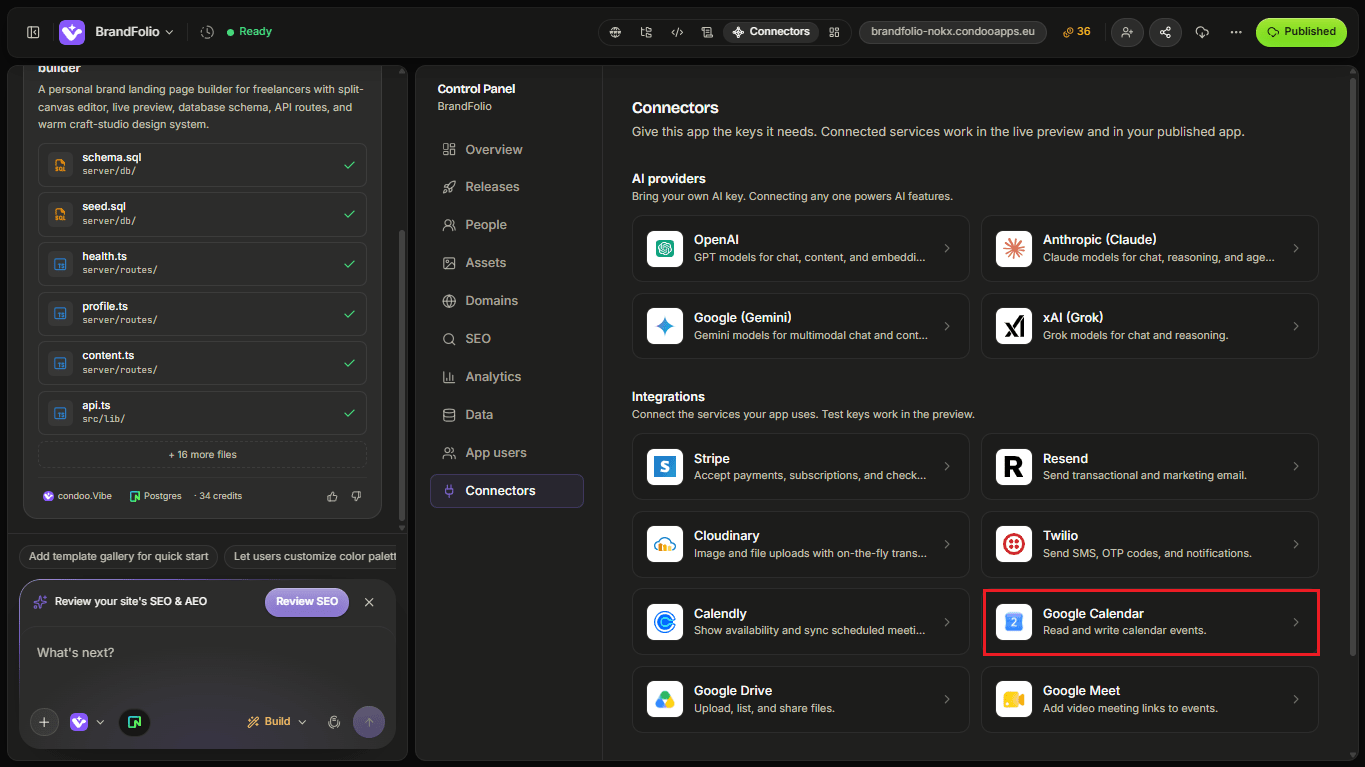
Follow the authorization flow provided by condoo.Vibe.
You may be asked to sign in with Google and approve the permissions required for the integration.
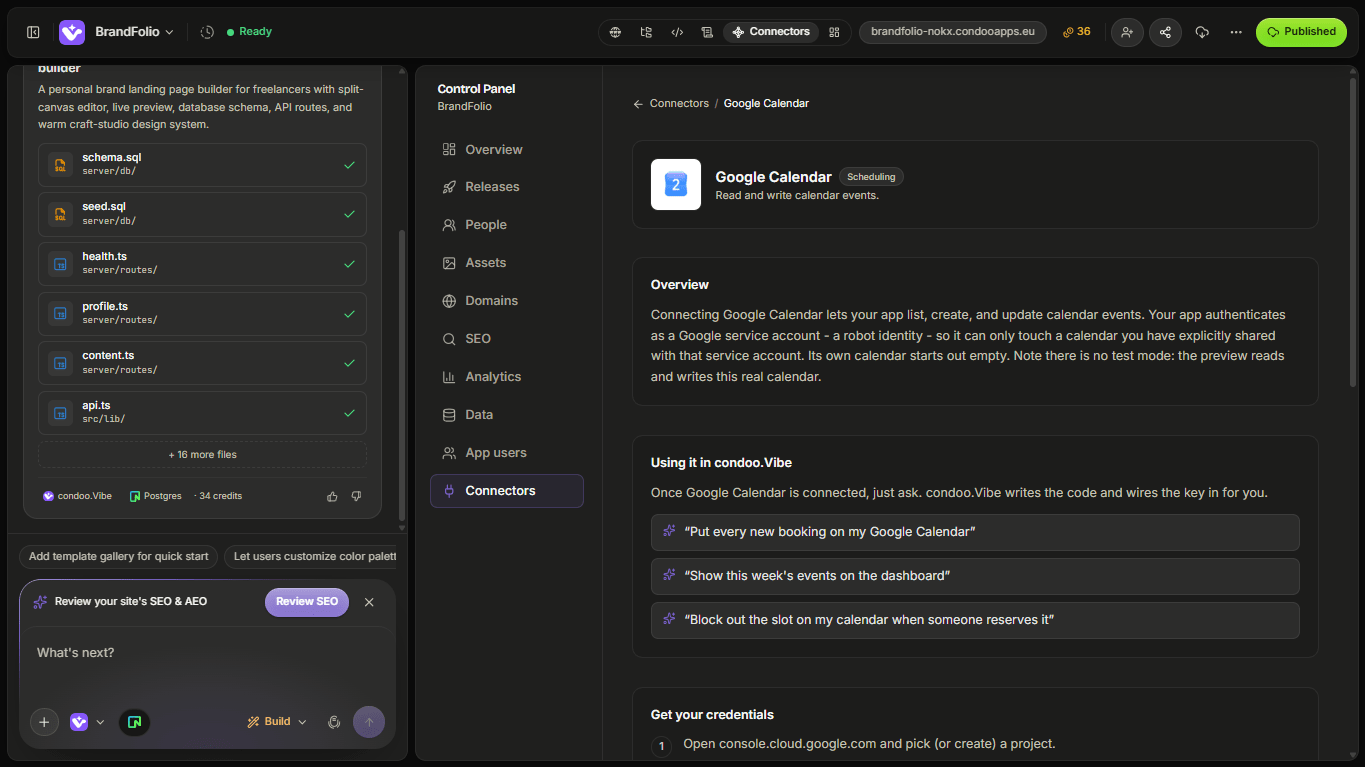
Once connected, you can begin asking condoo.Vibe to build calendar functionality into your application.
Create Your First Calendar Event
Suppose you're building a consultation booking application.
You could tell condoo.Vibe:
After a consultation is successfully confirmed, create a Google Calendar event containing the customer's name, consultation type, date, time, and contact information.
Conceptually:
Consultation Confirmed
        ↓
Save Booking
        ↓
Google Calendar
        ↓
Create Event
        ↓
Calendar Updated
The customer completes a normal workflow while your application handles the calendar action behind it.
Define the Event Details
Be clear about what should appear in the calendar event.
For example:
Create a 60-minute calendar event titled "Strategy Consultation: Sarah Chen." Include the customer's email, phone number, booking reference, and notes in the event details.
Useful event information may include:
- Event title
- Start date and time
- End date and time
- Description
- Attendees
- Location
- Meeting information
- Customer details
- Internal reference
Think about what someone viewing the calendar will actually need.
Example: Appointment Booking
Suppose you're building an appointment system for a salon.
A customer chooses:
Service
Hair Consultation

Stylist
Jessica

Date
September 15

Time
2:00 PM
After the booking is confirmed:
Booking
   ↓
Neon
   ↓
Google Calendar
   ↓
Jessica's Calendar
You could ask condoo.Vibe:
When a Hair Consultation is confirmed with Jessica, create the corresponding event on the connected Google Calendar. Include the customer's name, email, phone number, service, and booking reference.
Now your internal calendar can reflect activity happening inside the application.
Example: CRM Follow-Up
Calendar functionality isn't limited to customer appointments.
Imagine a salesperson is working with a lead.
You could build:
Add a Schedule Follow-Up action to each lead. The sales representative should choose a date and time, add notes, and create the follow-up as a Google Calendar event.
The workflow becomes:
Lead
 ↓
Schedule Follow-Up
 ↓
Choose Date & Time
 ↓
Google Calendar
 ↓
Event Created
This connects CRM activity with the salesperson's actual calendar.
Example: Customer Onboarding
Suppose a new customer needs an onboarding meeting.
You could ask:
When an Agency customer schedules their onboarding session, create a calendar event containing their company name, primary contact, plan, and onboarding notes.
The account manager now sees the onboarding session directly in their calendar.
Add Attendees
Some events need participants.
For example:
Create the consultation event and add the customer's email address as an attendee.
Or:
Add the customer, account manager, and implementation specialist to the onboarding meeting.
Conceptually:
Application
    ↓
Create Event
    ↓
Customer
Account Manager
Implementation Specialist
Where supported by the integration, attendees can receive the appropriate Google Calendar invitation experience.
Use Application Data
Calendar events can use information already stored in your application.
Suppose your CRM knows:
Lead
Sarah Chen

Company
Acme Ltd.

Email
sarah@...

Deal
$15,000

Owner
Michael
Instead of making the salesperson re-enter everything, you could tell condoo.Vibe:
When creating a meeting from a lead record, automatically include the lead's name, company, email, deal value, and assigned sales representative.
Your database becomes context for the calendar workflow.
Keep Calendar and Application Data Connected
Creating an event is only part of the workflow.
Your application may also need to remember the relationship between the event and the corresponding record.
Conceptually:
CRM Lead
   ↕
Meeting Record
   ↕
Google Calendar Event
This can help your application understand which calendar event belongs to which booking, customer, lead, or project.
For example, a lead page might show:
Upcoming Meeting

Product Demo
September 15 · 2:00 PM

[View Meeting]
Updating Events
Plans change.
Suppose an appointment moves from:
September 15 at 2:00 PM
to:
September 16 at 4:00 PM
If your application supports changing the booking, the corresponding calendar event may also need to change.
You could tell condoo.Vibe:
When an appointment is rescheduled, update the existing Google Calendar event rather than creating another event.
Conceptually:
Booking Updated
      ↓
Find Existing Event
      ↓
Update Date & Time
      ↓
Google Calendar
This helps prevent duplicate events.
Cancelling Events
The same principle applies to cancellations.
For example:
When a confirmed consultation is cancelled, cancel or remove the corresponding Google Calendar event and update the booking status.
Your systems should remain synchronized.
Booking Cancelled
       ↓
Application Updated
       ↓
Calendar Updated
Otherwise, staff could see meetings on their calendar that no longer exist in the application.
Avoid Duplicate Events
One confirmed booking should generally create one calendar event.
Refreshing a page or reopening a booking shouldn't create another one.
For example:
Booking #10482
      ↓
Calendar Event
      ✓
not:
Booking #10482
      ↓
Event
Event
Event
Event
Tie calendar creation to the actual business event, such as booking confirmed, rather than a page load.
Time Zones
Time zones are especially important with calendars.
Imagine:
Customer
New York

Consultant
Lagos
A meeting must still represent the same moment for both people.
Your application should store and process time information consistently and display it appropriately for the user.
When debugging calendar issues, always check whether the underlying problem is actually a timezone conversion problem.
Google Calendar + Google Meet
Google Calendar can also work alongside the Google Meet connector.
For example:
Meeting Scheduled
       ↓
Create Google Meet
       ↓
Create Calendar Event
       ↓
Add Meeting Link
       ↓
Invite Attendees
You could tell condoo.Vibe:
When a customer schedules a remote consultation, create a Google Meet meeting and add it to the corresponding Google Calendar event.
We'll cover Google Meet on the next page.
Google Calendar + Resend
You can also create follow-up communication around calendar workflows.
For example:
Appointment Confirmed
       ↓
Create Calendar Event
       ↓
Resend
       ↓
Confirmation Email
You could ask:
After a consultation is confirmed, create the Google Calendar event and send the customer a confirmation email through Resend containing the appointment details.
This is where connectors become especially powerful: multiple services can participate in one application workflow.
Google Calendar + Twilio
For appointment-driven products:
Create the appointment on Google Calendar and send the customer an SMS reminder 24 hours before the meeting.
Conceptually:
Appointment
    ↓
Google Calendar
    ↓
Reminder Time
    ↓
Twilio
    ↓
Customer
Again, your application coordinates the workflow.
Permissions
Calendar access can involve sensitive information.
Only request and use the access required for your feature.
For example, there's a difference between an application that needs to:
Create calendar events
and one that needs to:
Read and manage existing calendar information.
The appropriate authorization depends on what your application actually needs to do.
Common Problems
Calendar event isn't created
First check whether the main application action succeeds.
For example:
The booking is saved successfully, but no Google Calendar event appears.
That isolates the issue to the calendar portion of the workflow.
Event appears at the wrong time
This is often worth checking as a timezone issue.
Tell condoo.Vibe:
The booking shows 2:00 PM WAT correctly in the application, but the Google Calendar event appears one hour later. Debug the timezone handling without changing the booking time itself.
Duplicate events appear
Tell condoo.Vibe:
One confirmed appointment sometimes creates multiple Google Calendar events. Audit the event creation trigger and ensure each booking maps to only one calendar event.
Event doesn't update after rescheduling
Tell condoo.Vibe:
Rescheduling updates the booking correctly, but the original Google Calendar event remains unchanged. Update the existing calendar event when the booking is rescheduled rather than creating another event.
Authorization fails
Check whether:
- The correct Google account is being used
- Authorization was completed
- Required permissions were granted
- The connection is still valid
If Google returns an error, provide the error to condoo.Vibe's Debug Mode without sharing private credentials.
Debugging Google Calendar
A good Debug Mode request could look like:
Expected: After a consultation is confirmed, a Google Calendar event should be created for the appointment.
Actual: The booking saves correctly in the application, but no calendar event appears.
The booking date and time are stored correctly.
Error: [PASTE ERROR IF AVAILABLE]
Debug the Google Calendar portion of the workflow without changing the booking functionality.
This gives condoo.Vibe a specific integration boundary to investigate.
Test Your Calendar Workflow
Before publishing, test:
- Event creation
- Event title
- Start and end time
- Time zones
- Description
- Attendees
- Rescheduling
- Cancellation
- Duplicate prevention
- Application-to-calendar relationship
- Authorization failures
- Mobile experience
- Different user roles
For booking applications, test the complete lifecycle:
CREATE
  ↓
RESCHEDULE
  ↓
CANCEL
Not just event creation.
A Good Google Calendar Prompt
A strong request defines:
- Trigger: When should the event be created?
- Calendar: Where should it go?
- Details: What should it contain?
- Attendees: Who should participate?
- Updates: What happens if the source record changes?
- Cancellation: What happens if it's cancelled?
For example:
When a consultation booking is confirmed, create a Google Calendar event using the booking's start and end time. Title it with the consultation type and customer's name. Include their contact information and booking reference in the description and add the customer as an attendee. If the booking is rescheduled, update the existing event. If it's cancelled, cancel the corresponding calendar event. Ensure one booking cannot create duplicate events.
That's significantly stronger than:
Add Google Calendar.
Think in Calendar Workflows
A useful mental model is:
APPLICATION EVENT
       ↓
CALENDAR ACTION
       ↓
SAVE RELATIONSHIP
       ↓
KEEP IN SYNC
       ↓
UPDATE / CANCEL
Google Calendar handles the calendar.
condoo.Vibe builds the product logic around it.
Next: Google Meet
Next, we'll add Google Meet.
We'll cover how condoo.Vibe-built applications can incorporate video meetings into workflows such as:
- Sales demos
- Consultations
- Interviews
- Customer onboarding
- Team meetings
- Virtual appointments
We'll also show how Google Meet + Google Calendar can work together to create a complete meeting experience.