 condoo.Vibe
Google Drive
Connect Google Drive to bring project files, client documents, and shared resources into workflows you build with condoo.Vibe.
The Google Drive connector lets applications you build with condoo.Vibe work with files and documents stored in Google Drive.
You can use Google Drive for experiences such as:
- Client file access
- Project documents
- Shared resources
- Internal team files
- Document workflows
- Linking application records to Drive files
- File organization
- Document-driven product features
Connect Google Drive. Define how files should be used. condoo.Vibe builds the workflow around them.
What You Can Build
Google Drive can become part of many application workflows.
Client portals
Show customers the files and documents associated with their projects.
Project management
Link project records to folders or documents stored in Google Drive.
Internal tools
Give team members access to approved company documents from inside the application.
Onboarding
Show new customers the onboarding documents associated with their account.
Document workflows
Allow users to choose a Drive document and use it as input for another application workflow.
The application determines how the files fit into the user experience.
Before You Start
You'll need a Google account and the authorization required by condoo.Vibe's Google Drive connector.
The connected account determines which Google Drive content the application can access based on the permissions granted.
Connect Google Drive to condoo.Vibe
Open your condoo.Vibe project and navigate to Connectors.
Find Google Drive and select it.
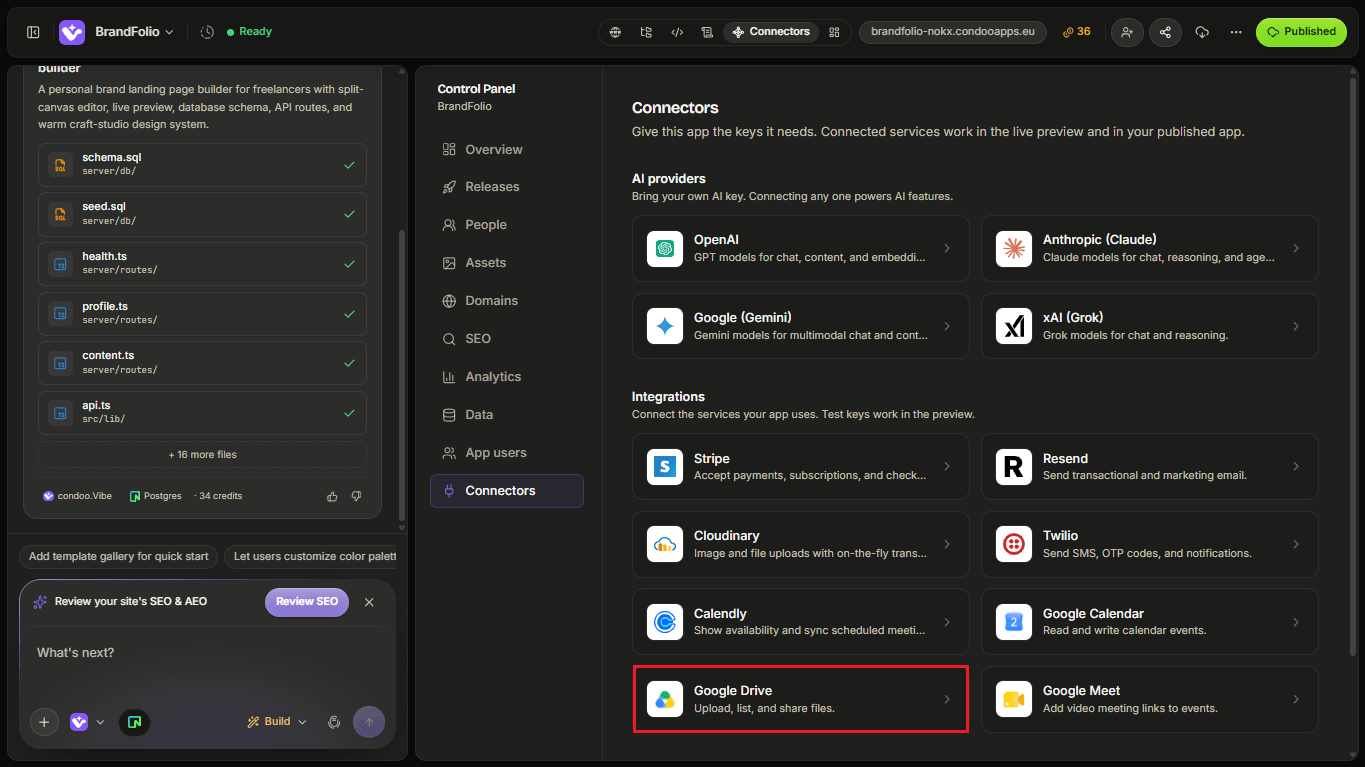
Follow the Google authorization flow provided by condoo.Vibe.
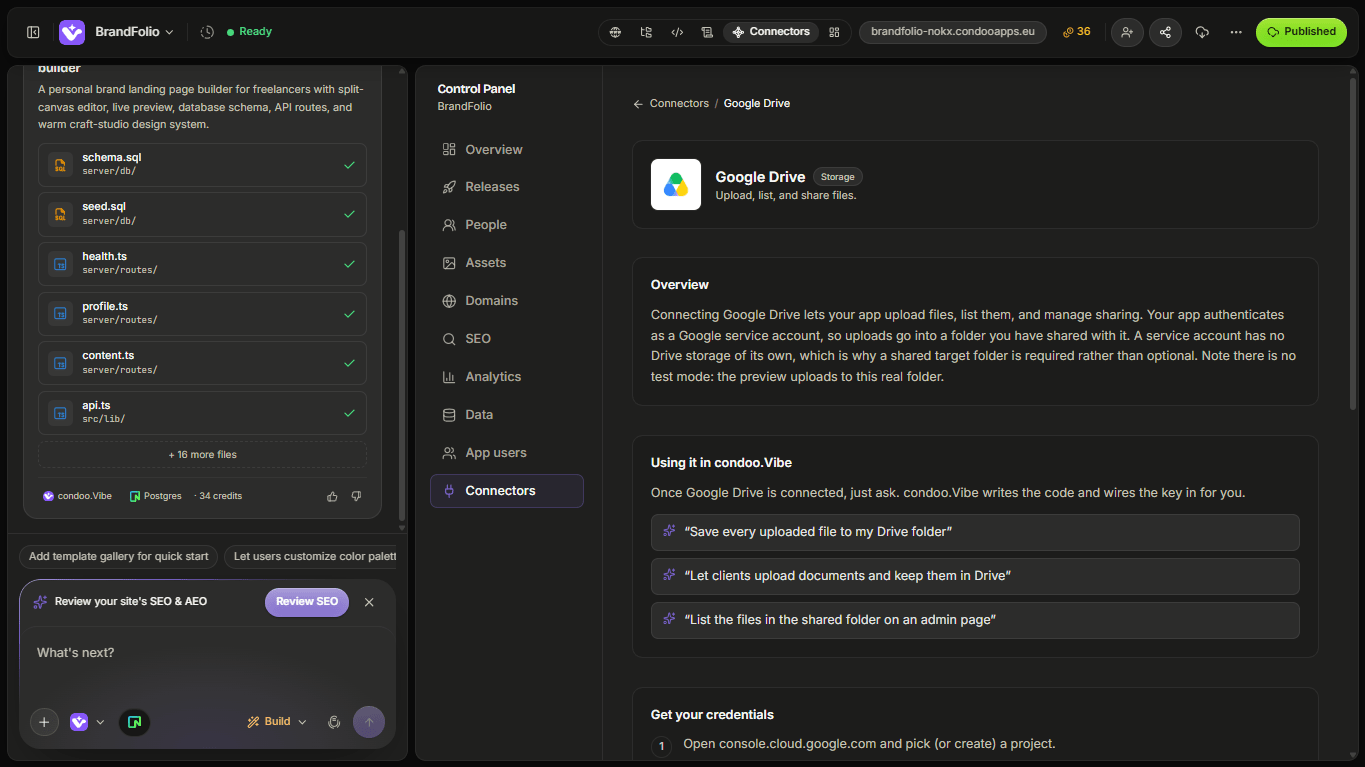
Once connected, you can begin asking condoo.Vibe to build Drive-powered functionality into your application.
Build Your First Drive Workflow
Suppose you're building a client portal.
Tell condoo.Vibe:
Add a Files section to each client project. Allow the application to display the Google Drive files associated with that project.
Conceptually:
Client Project
      ↓
Google Drive
      ↓
Project Files
      ↓
Client Portal
The customer interacts with your portal while Google Drive provides the underlying file source.
Application Records and Drive Files
A useful application usually needs to understand which files belong to which records.
For example:
Customer
   ↓
Project
   ↓
Drive Folder
   ↓
Project Files
You might tell condoo.Vibe:
Each project should have an associated Google Drive folder. Show the folder's approved documents inside the project detail page.
This connects application data with external file storage.
Example: Agency Client Portal
Imagine an agency manages multiple customers.
Each customer has projects, and each project has files.
You could ask:
Add a Files tab to the client portal. Show Google Drive files associated with the customer's projects and group them by project. Customers should only see files belonging to their own account.
This combines:
- Authentication
- Authorization
- Project data
- Google Drive
Conceptually:
Signed-In Customer
       ↓
Verify Project Access
       ↓
Find Associated Drive Files
       ↓
Display Approved Files
Example: Project Resources
For a project management application:
Add a Resources section to each project where team members can access documents stored in the project's connected Google Drive folder.
You might display:
Project Resources

Brand Guidelines.pdf
Campaign Brief.docx
Product Images
Research Notes
The application becomes a more convenient interface for accessing project resources.
Example: Customer Onboarding
Suppose new customers need onboarding documents.
You could ask:
After a customer completes onboarding, show the Welcome Guide, Implementation Checklist, and Training Resources from the connected Google Drive folder inside their dashboard.
Now Drive participates in the onboarding experience.
Example: Document Review
Google Drive can also provide files for AI-powered workflows.
For example:
Allow authorized users to select a Google Drive document and generate an executive summary using Claude.
Conceptually:
Google Drive
     ↓
Select Document
     ↓
Retrieve Content
     ↓
Claude
     ↓
Summary
     ↓
condoo.Vibe Application
This combines Google Drive with an AI provider.
Example: Proposal Workflow
Imagine you're building sales software.
You could create:
Opportunity
   ↓
Proposal
   ↓
Google Drive Document
Tell condoo.Vibe:
Allow sales representatives to attach an existing Google Drive proposal to an opportunity. Show the proposal from the deal detail page.
Now the CRM and file system are connected.
Folder Organization
For applications with many records, folder organization can matter.
For example:
Clients
├── Acme Ltd
│   ├── Website Redesign
│   └── SEO Campaign
│
├── Northstar
│   ├── Branding
│   └── Ads
You can describe how your application's records should relate to those folders.
For example:
Each client project should be associated with one Google Drive folder. Don't expose files from folders belonging to another customer.
Permissions Matter
A user being authenticated in your application doesn't automatically mean they should see every file accessible through the connected Google account.
Your application still needs authorization rules.
For example:
Customers should only see Drive files associated with projects belonging to their account. Internal team members can see all files within their assigned workspace.
Public vs Private Files
Some files may be intended for:
- Everyone
- Signed-in users
- Specific customers
- Specific project members
- Internal staff only
Tell condoo.Vibe what access model you want.
For example:
Marketing resources can be viewed by all authenticated customers, but project documents should only be visible to users associated with that project.
This gives condoo.Vibe clearer requirements for the file experience.
File Metadata
Your application may want to display information such as:
- Filename
- File type
- Updated date
- Owner
- Project
- Folder
- Link
For example:
Campaign Brief.pdf
PDF · Updated Aug 24

[Open]
You can ask condoo.Vibe to display the metadata that matters for your product.
Searching Files
If a project contains many files, users may need search.
For example:
Add search to the project Files section so users can search documents by filename.
Or:
Add filters for PDF, document, spreadsheet, and image files.
The exact functionality depends on what information the Drive integration makes available.
Uploading Files
If the connector supports the required upload workflow, you may want users to add files to Drive through your application.
For example:
Allow project managers to upload approved documents to the project's connected Google Drive folder from inside the application.
You should also define:
- Who can upload
- Which folder receives the file
- Accepted file types
- Maximum file size
- Whether customers can upload
- What happens after upload
Deleting Files
File deletion is potentially destructive.
If your application allows it, define the permission rules carefully.
For example:
Customers can download files but cannot delete them. Only workspace Owners and Admins can remove Drive files from the project.
You may also want a confirmation step before destructive actions.
Updating Files
Google Drive files may change outside your condoo.Vibe application.
For example, someone might update a document directly in Drive.
Your application should ideally use the current Drive information rather than maintaining stale duplicate copies where appropriate.
Think carefully about whether your application needs to:
Reference the Drive file
or
Copy its contents into your own database.
Those are different architectures.
Google Drive vs Cloudinary
Google Drive and Cloudinary serve different use cases.
Cloudinary
Best suited to application media workflows such as:
- Profile photos
- Product images
- Property galleries
- Image optimization
- Media delivery
Google Drive
Better suited to file and document workflows such as:
- Client documents
- Project resources
- Internal files
- Shared documents
- Drive-based business workflows
For example:
Property Photo
→ Cloudinary
while:
Signed Property Contract
→ Google Drive
The right connector depends on the type of content and how your product needs to use it.
Google Drive + AI
Drive becomes particularly interesting when combined with AI models.
For example:
Drive Document
     ↓
OpenAI / Claude / Gemini
     ↓
Summarize
     ↓
Extract
     ↓
Classify
     ↓
condoo.Vibe Application
You could ask:
Allow users to select a document from Google Drive and generate a structured summary containing key points, decisions, deadlines, and action items.
Or:
Analyze a selected proposal and extract the customer, price, scope, and delivery timeline into the CRM.
This turns files into usable application workflows.
Google Drive + Client Portal
A strong combined workflow could be:
Agency Uploads File
       ↓
Google Drive
       ↓
Project Record
       ↓
Client Portal
       ↓
Customer Opens File
You could then add:
Notify the customer through Resend whenever a new approved project file becomes available.
Now another connector joins the workflow.
Google Drive + Resend
For example:
When a project manager adds a new approved document to a customer's project, email the customer and include a link back to the Files section of their portal.
Conceptually:
New Project File
       ↓
Application
       ↓
Resend
       ↓
Customer Notification
Common Problems
Files don't appear
First determine whether:
- Google Drive is connected
- The correct account is authorized
- The expected folder/file exists
- The application is using the correct reference
- The signed-in user has permission to see it
Wrong customer's files appear
This is a serious authorization issue.
Tell condoo.Vibe:
Customer A can see Google Drive files belonging to Customer B. Audit the file authorization and project-to-folder relationship immediately. Ensure users can only access files associated with projects they are authorized to view.
File link doesn't work
Check whether the file still exists and whether the user's access model allows them to open it.
Files are outdated
Determine whether your application is storing stale metadata rather than retrieving the current Drive information where appropriate.
Authorization fails
Check:
- Correct Google account
- Completed authorization
- Granted permissions
- Whether the connector is still active
Provide any Google error message to Debug Mode without sharing private credentials.
Debugging Google Drive
A good Debug Mode prompt might look like:
Expected: When a customer opens the Files tab, they should see documents associated with their projects.
Actual: The project loads correctly, but the Files tab is empty.
The Google Drive folder contains documents.
Other project functionality works normally.
Error: [PASTE ERROR IF AVAILABLE]
Debug the Google Drive integration and project-to-folder relationship without changing the rest of the portal.
This helps isolate the file workflow.
Test Your Drive Workflow
Before publishing, test:
- Correct Google account
- Correct folder
- File listing
- File links
- Customer authorization
- Team authorization
- Multiple customers
- Multiple projects
- Empty folders
- Missing files
- Renamed files
- Updated files
- Uploads, if supported
- Deletion permissions, if supported
- Mobile experience
Most importantly, test data isolation using different user accounts, not only your administrator account.
A Good Google Drive Prompt
Define:
- What files are involved?
- Which application record owns them?
- Who can access them?
- Where should they appear?
- What actions can users perform?
For example:
Add a Files tab to each client project. Associate each project with its Google Drive folder and show the files from that folder inside the project. Customers should only see files belonging to projects associated with their account. Internal workspace members can see files for projects they have access to. Display filename, file type, and last updated date, and provide an Open action. Customers must not be able to delete files.
That's much stronger than:
Connect Google Drive.
Think in File Workflows
A useful mental model is:
APPLICATION RECORD
       ↓
DRIVE FILE / FOLDER
       ↓
ACCESS CONTROL
       ↓
USER EXPERIENCE
       ↓
OPTIONAL AUTOMATION
Google Drive stores and manages the files.
condoo.Vibe builds the application experience around them.
Next: Request a Connector
You've now covered the currently documented condoo.Vibe connectors:
- Stripe
- Resend
- Twilio
- Cloudinary
- OpenAI
- Anthropic
- Google Gemini
- xAI
- Calendly
- Google Calendar
- Google Meet
- Google Drive
But your application may need another service.
Next, we'll cover Request a Connector: what to do when the integration you need isn't currently available inside condoo.Vibe.